 Bill Burhans served as a tour officer with the USMLM Air Team from July 1971 to June 1975. He returned in 1979 to command Detachment 16,
7113th Special Activities Squadron (the Air Team), departing in early spring 1980 following a December 1979 Soviet-originated nasty incident.
He tells us how he managed to take a superb photo of a MiG-23UB.
Bill Burhans served as a tour officer with the USMLM Air Team from July 1971 to June 1975. He returned in 1979 to command Detachment 16,
7113th Special Activities Squadron (the Air Team), departing in early spring 1980 following a December 1979 Soviet-originated nasty incident.
He tells us how he managed to take a superb photo of a MiG-23UB.
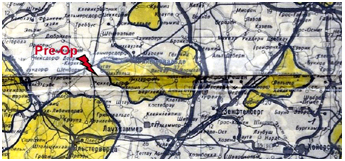
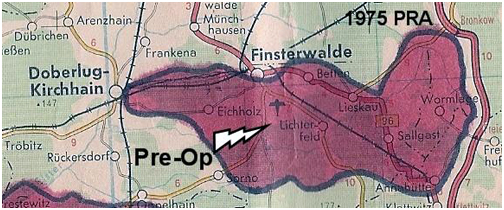
The MiG-23 FLOGGER fighter-interceptor had been introduced into the 16th Air Army in 1973. The following year, the USMLM Air Team received information that this aircraft would begin to be delivered to the fighter-bomber regiment at Finsterwalde. If this was true, it meant the Soviet 559th Fighter-Bomber Aviation Regiment would begin conversion to the new MiG-27 FLOGGER D fighter-bomber version of this airframe. On 1 March 1974, Nick Netter and I were tasked to cover flying activity at Finsterwalde Airfield in the hopes of obtaining coverage of this high-interest aircraft, which had rarely been seen in East Germany. As was the case for every Soviet and East German airfield, the facility was protected by a permanent restricted area (PRA), but in this case the PRA line on the Soviet-issued map ran along Fliegerstrasse, a road that circled to the south and then east around the airfield. The Finsterwalde PRA is shown on the left on the actual Soviet-issued PRA map as the yellow blob in the center of the photo (click on it).
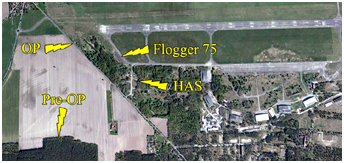
We were able to hide in an excellent pre-OP early this particular morning in the woods north of Pechhüte between the airfield inner marker beacon and the southwest end of the runway. The main highway between the cities of Finsterwalde and Doberlug was a few hundred meters from the wood line where we were positioned. Fliegerstrasse, the access road to the airfield, ran from that main road past the end of the runway. The PRA line followed that road, which meant we would be able to get very close to any action that might ensue. We waited and waited for flying activity to begin, but nothing transpired. About noon we decided to move on to our alternate targets so as not to lose the entire day and the good weather. We exited the woods and had a good look around us. It was obvious no one had detected our presence in the area. The lighting was very good and we both were aware that there was an aircraft hangarette located near the end of the runway right by the perimeter fence. There was a continuing requirement to find out the thickness of the hangarette arches and walls, so we decided to dash up close and see if we could get photography of sufficient quality to help answer that question. We made a dash for the access road, Nick concentrating on the driving while I watched for any narks or other surveillance. We both happened to glance towards the runway at about the same time. Each of us let out a whoop!
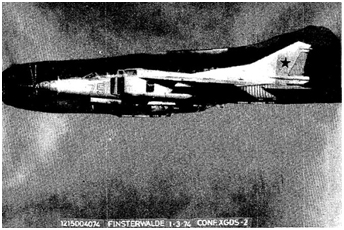
 We had caught a FLOGGER C, the MiG-23 two-seat trainer, parked on the taxiway at the end of the
runway. There was no traffic in sight, the ground to either side of the road was hard, there were no ditches
and conditions seemed perfect. We remained on the access road about 400 yards from this bird. Nick
positioned the car such that I had a perfect view of the aircraft. I shot an entire 36-exposure roll of black
and white Tri-X film using the 1000-mm lens. I shot another roll using the 500-mm lens. Things still
seemed very quiet so I burned off several frames of Ektrachrome color film using the 180-mm lens, and
the 500-mm again. I then took several frames using the 50-mm lens.
Finally, we began to attract a bit of attention. The Ford four-door sedan with the dull green paint job
and bright yellow license plate was readily identifiable, but Nick and I were fortunate. No military
vehicles had used the road during this time, because the military personnel probably were eating lunch. A
couple of civilian vehicles had gone by, but no one paid us any heed.
After we had been in position almost 10 minutes, a civilian vehicle exited the airfield area and headed
towards us to the main highway. We did not pay it much attention as it drove past us, but that quickly
changed. The car screeched to a halt about 100 feet away. A Soviet captain jumped out, took a long look
at the car and license plate, and began to run towards us. I clearly remember looking back at this officer
over my shoulder and watching him trying to pull his holster around from the back to the front of his
overcoat so he could get at his weapon. Nick and I decided the better part of valor was to get the heck out
of there. I think we must have been out of range when he finally did draw his pistol. He may have been
able to get a round off at us, but, if he did, fortunately he did not hit us.
However, our being on that road technically could have put us in a permanent restricted area, but this
was arguable. The point of contention would be determination of the exact point where the PRA line on
the map translated to actual terrain. In other words, how thick was the line drawn on the official PRA
map? If that main road were in the PRA, it would only be inside the line several dozen feet. This might
seem to be minor point perhaps, but it was a key one nonetheless.
We had caught a FLOGGER C, the MiG-23 two-seat trainer, parked on the taxiway at the end of the
runway. There was no traffic in sight, the ground to either side of the road was hard, there were no ditches
and conditions seemed perfect. We remained on the access road about 400 yards from this bird. Nick
positioned the car such that I had a perfect view of the aircraft. I shot an entire 36-exposure roll of black
and white Tri-X film using the 1000-mm lens. I shot another roll using the 500-mm lens. Things still
seemed very quiet so I burned off several frames of Ektrachrome color film using the 180-mm lens, and
the 500-mm again. I then took several frames using the 50-mm lens.
Finally, we began to attract a bit of attention. The Ford four-door sedan with the dull green paint job
and bright yellow license plate was readily identifiable, but Nick and I were fortunate. No military
vehicles had used the road during this time, because the military personnel probably were eating lunch. A
couple of civilian vehicles had gone by, but no one paid us any heed.
After we had been in position almost 10 minutes, a civilian vehicle exited the airfield area and headed
towards us to the main highway. We did not pay it much attention as it drove past us, but that quickly
changed. The car screeched to a halt about 100 feet away. A Soviet captain jumped out, took a long look
at the car and license plate, and began to run towards us. I clearly remember looking back at this officer
over my shoulder and watching him trying to pull his holster around from the back to the front of his
overcoat so he could get at his weapon. Nick and I decided the better part of valor was to get the heck out
of there. I think we must have been out of range when he finally did draw his pistol. He may have been
able to get a round off at us, but, if he did, fortunately he did not hit us.
However, our being on that road technically could have put us in a permanent restricted area, but this
was arguable. The point of contention would be determination of the exact point where the PRA line on
the map translated to actual terrain. In other words, how thick was the line drawn on the official PRA
map? If that main road were in the PRA, it would only be inside the line several dozen feet. This might
seem to be minor point perhaps, but it was a key one nonetheless.
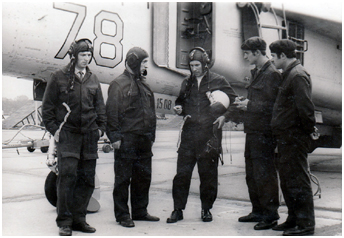
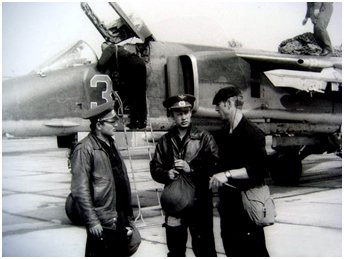 If detained there, the Soviets could claim the reconnaissance tour had violated this PRA. Not only
that, the tour personnel could find themselves in serious trouble with the Chief of Mission if he learned
we had been that close, pushing the PRA boundary. Thank heaven for the 1000-mm lens! If absolutely
necessary, use of this wonderful piece of equipment could provide probable denial if any question came
up about the exact spot from which a particular photograph had been taken.
Using the 180-mm lens, the aircraft filled the frame nicely. Using the 500-mm lens, I had to burn off
two frames to get the entire aircraft. With the 1000-mm lens, it took eight frames to encompass the entire
aircraft. Putting the eight enlarged prints together to produce a panorama, the picture was 1½ feet tall and
3½ feet wide. It looked wonderful displayed on the Wall of Honor in the Air Team Operations Officer's
office!
There was no doubt that we had hit the jackpot with this coverage. We not only confirmed the
presence of FLOGGER at Finsterwalde at the CONFIDENTIAL level allowing wider dissemination of
the information, but we had outstanding pictures as well.
We headed into the woods not far from Sorno (the Drossiger Heide), drove around a bit to make it
harder for anyone to track us and then found a small clearing. Nick stopped the car and the two of us
jumped out and we began to shout at the tops of our lungs. We had done it, we had killed FLOGGER! We
had destroyed it!
This was the best technical photography of this airframe obtained up to that time. One could read the
notations on the maintenance panels on the fuselage.
If detained there, the Soviets could claim the reconnaissance tour had violated this PRA. Not only
that, the tour personnel could find themselves in serious trouble with the Chief of Mission if he learned
we had been that close, pushing the PRA boundary. Thank heaven for the 1000-mm lens! If absolutely
necessary, use of this wonderful piece of equipment could provide probable denial if any question came
up about the exact spot from which a particular photograph had been taken.
Using the 180-mm lens, the aircraft filled the frame nicely. Using the 500-mm lens, I had to burn off
two frames to get the entire aircraft. With the 1000-mm lens, it took eight frames to encompass the entire
aircraft. Putting the eight enlarged prints together to produce a panorama, the picture was 1½ feet tall and
3½ feet wide. It looked wonderful displayed on the Wall of Honor in the Air Team Operations Officer's
office!
There was no doubt that we had hit the jackpot with this coverage. We not only confirmed the
presence of FLOGGER at Finsterwalde at the CONFIDENTIAL level allowing wider dissemination of
the information, but we had outstanding pictures as well.
We headed into the woods not far from Sorno (the Drossiger Heide), drove around a bit to make it
harder for anyone to track us and then found a small clearing. Nick stopped the car and the two of us
jumped out and we began to shout at the tops of our lungs. We had done it, we had killed FLOGGER! We
had destroyed it!
This was the best technical photography of this airframe obtained up to that time. One could read the
notations on the maintenance panels on the fuselage.
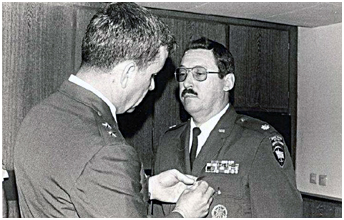 Bill Burhans est décoré de la Meritorious Service Medal par le Maj. Gen. J. Allen. © B.Burhans.
Maj. Gen. J. Allen presents the Meritorious Service Medal to Bill Burhans. © B.Burhans.
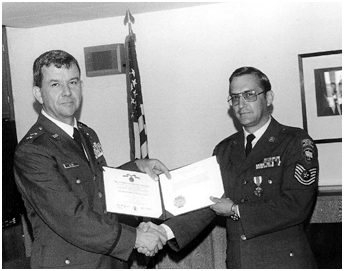 Nick Netter est décoré de la Meritorious Service Medal par le Maj. Gen. J. Allen. © B.Burhans.
Maj. Gen. J. Allen presents the Meritorious Service Medal to Nick Netter. © B.Burhans.
The photos were hand-carried to USAFE
Headquarters in Wiesbaden. CINC USAFE deemed this collection effort of enough significance that he
detailed an officer (Major Steve V. Mrak, formerly my boss at Goodfellow and instrumental in helping
me get my commission in 1963) to take the photographs to Washington, D. C. and personally brief the
Secretary of Defense.
This photography was of such stellar quality and was such an important contribution to the US intelligence community's knowledge on this new weapons system that the Commander-in-Chief, United States
Air Forces in Europe approved the award of the Meritorious Service Medal for Achievement to Nick
Netter and me. Major General Jesse Allen, USAFE Deputy Chief of Staff for Operations and Intelligence,
flew up to Berlin a month or so later to present our medals during a brief ceremony at Tempelhof Central
Airport in West Berlin.
In about June 1975, the Soviets issued the three allied military liaison missions a new PRA map.
Below is a close-up photo of the new Finsterwalde PRA. When compared to the 1974 version,
it is clear that the Soviet side had corrected their previous error of not restricting access to the area
immediately adjacent to the west end of the Finsterwalde Soviet Airfield runway.
Do you suppose that the bad guys somehow had gotten access to the FLOGGER 75 photo??? It
certainly would not surprise me at all if that had been the case back then during the Cold War days...
 |
Plan du site - Sitemap |  |

