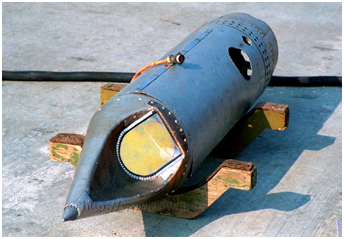
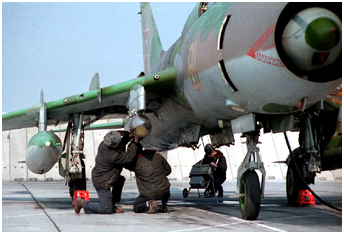
 As we saw in Parts 4 and 5 of this chapter, the MiG-27K, D, and M sometimes carried a ventral container designated FKP-58 (> Link) intended to record the firing sequence of air-to-ground missiles on magnetic tape. Furthermore, there was also a reconnaissance pod designated PA-10 (> Link) that was dedicated to the MiG-27.
According to Russian literature, the Su-17 was also likely to carry an FKP-58 container attached to the right pylon originally intended to carry an R-60 missile. This same literature does not provide any photos and the book entitled "The Su-17 in Combat" (Su-17 v Boyu) shows us a drawing very different from what one might expect - perhaps a mistake?
As we saw in Parts 4 and 5 of this chapter, the MiG-27K, D, and M sometimes carried a ventral container designated FKP-58 (> Link) intended to record the firing sequence of air-to-ground missiles on magnetic tape. Furthermore, there was also a reconnaissance pod designated PA-10 (> Link) that was dedicated to the MiG-27.
According to Russian literature, the Su-17 was also likely to carry an FKP-58 container attached to the right pylon originally intended to carry an R-60 missile. This same literature does not provide any photos and the book entitled "The Su-17 in Combat" (Su-17 v Boyu) shows us a drawing very different from what one might expect - perhaps a mistake?
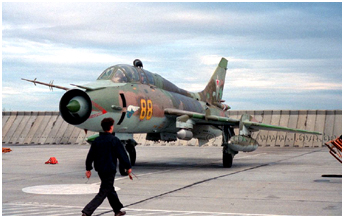
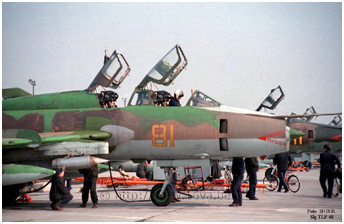 But new photos emerged from the shadows a few months after the last update of this chapter. They show a photo or camera pod mounted under the left or right inboard pylon of Su-17UM3s based at Gross Dölln.
These containers are clearly modified UB-16 rocket pods, perhaps at unit level. Since we don't know their contents, two hypotheses are possible. They could be an improvised FKP container intended to record missile launches or photo pods. Compared to the FKP-58 container of the MiG-27s, this one is smaller (see this photo of a MiG-27K with an FKP-58 and a UB-16 rocket pod > Link). Was it therefore possible to house both a camera and a tape recorder inside? We should also note that while the MiG-27's FKP-58 container resembles a fuel tank, it lacks the "cobbled-together" character of the modified UB-16 pods.
But let's hear from Guards Colonel Tamarovski, who was contacted about this in October 2025. It appears to be a pod nicknamed "Penguin," designed to check the firing results, which may contain an AFA-39 camera. A poor man's FKP-58, so to speak!
The following anecdote comes to mind. During a final visit to the 20.GvAPIB a few weeks before their departure from Germany, Guards Colonel Kalinin showed us some photos he had taken while flying over the airfield. Were they taken with this type of container? At that time, the last units still based in the former GDR could hardly carry out operational missions. Colonel Tamarovski was already referring to his airfield as the "Gross Dölln Aeroclub" in 1992, after the withdrawal of the ground-to-air defense units...
But new photos emerged from the shadows a few months after the last update of this chapter. They show a photo or camera pod mounted under the left or right inboard pylon of Su-17UM3s based at Gross Dölln.
These containers are clearly modified UB-16 rocket pods, perhaps at unit level. Since we don't know their contents, two hypotheses are possible. They could be an improvised FKP container intended to record missile launches or photo pods. Compared to the FKP-58 container of the MiG-27s, this one is smaller (see this photo of a MiG-27K with an FKP-58 and a UB-16 rocket pod > Link). Was it therefore possible to house both a camera and a tape recorder inside? We should also note that while the MiG-27's FKP-58 container resembles a fuel tank, it lacks the "cobbled-together" character of the modified UB-16 pods.
But let's hear from Guards Colonel Tamarovski, who was contacted about this in October 2025. It appears to be a pod nicknamed "Penguin," designed to check the firing results, which may contain an AFA-39 camera. A poor man's FKP-58, so to speak!
The following anecdote comes to mind. During a final visit to the 20.GvAPIB a few weeks before their departure from Germany, Guards Colonel Kalinin showed us some photos he had taken while flying over the airfield. Were they taken with this type of container? At that time, the last units still based in the former GDR could hardly carry out operational missions. Colonel Tamarovski was already referring to his airfield as the "Gross Dölln Aeroclub" in 1992, after the withdrawal of the ground-to-air defense units...
 |
Plan du site - Sitemap |  |

