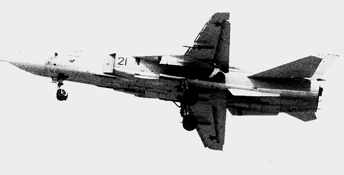
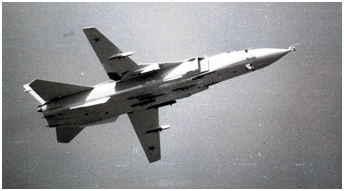
 While the first unit of the 16.VA to receive Su-24s was the 116.GvBAP (formerly 116.GvAPIB) at Brand in 1982, the "Fencers" had already made a notable appearance in East Germany as early as 1979. Initially known in the West by the erroneous designation Su-19, only sketches or rough photographs of the aircraft existed.
The first unit to introduce the Su-24 into service was the 455th IIAP (Research and Instruction Aviation Regiment) based in Voronezh (Baltimor). The 455th IIAP was subordinate to the 4.TsBP i PLS (Center for Combat Employment and Retraining of Aircrew) from Lipetsk. In addition to its missions related to the operational deployment of the Su-24 and personnel training (operational conversion), the unit presented and demonstrated the capabilities of the new aircraft to delegations of officers at various airbases. Eight aircraft participated in Exercise "Udar-79" in July 1979, during which Su-24s were deployed to Gross Dölln for the duration of the exercise. This was the first deployment of Su-24s outside the borders of the USSR.
While the first unit of the 16.VA to receive Su-24s was the 116.GvBAP (formerly 116.GvAPIB) at Brand in 1982, the "Fencers" had already made a notable appearance in East Germany as early as 1979. Initially known in the West by the erroneous designation Su-19, only sketches or rough photographs of the aircraft existed.
The first unit to introduce the Su-24 into service was the 455th IIAP (Research and Instruction Aviation Regiment) based in Voronezh (Baltimor). The 455th IIAP was subordinate to the 4.TsBP i PLS (Center for Combat Employment and Retraining of Aircrew) from Lipetsk. In addition to its missions related to the operational deployment of the Su-24 and personnel training (operational conversion), the unit presented and demonstrated the capabilities of the new aircraft to delegations of officers at various airbases. Eight aircraft participated in Exercise "Udar-79" in July 1979, during which Su-24s were deployed to Gross Dölln for the duration of the exercise. This was the first deployment of Su-24s outside the borders of the USSR.
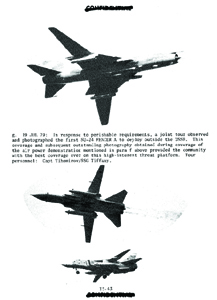 Having learned of this event, US intelligence, through its military liaison mission, informed the other allied missions in order to organize a joint intelligence operation to best cover this crucial target. We know from the 1979 USMLM Unit History that the Su-24s were present at least on July 19th. The French and American missions succeeded in collecting the first usable photographs of Su-24s, which unfortunately did not leak to the specialized press as was sometimes the case.
Probably as part of Exercise "Udar-79," an air power demonstration also took place at the Wittstock firing range during the same period. The preparation and execution of this demonstration were also documented from July 10 to 27 by the three missions, and it appears that the Su-24s participated.
Su-17M2s were identified among the aircraft that took part in the demonstrations. Only the 497.APIB flew this type of aircraft within the 16.VA. Incidentally, this fighter-bomber regiment
was renamed the 497.BAP in 1985 when it was re-equipped with the Su-24s from Brand. The testimony of a pilot from the 497.APIB, almost certainly concerning the events described above, has already been published on this site
> Total Mobilization!
Having learned of this event, US intelligence, through its military liaison mission, informed the other allied missions in order to organize a joint intelligence operation to best cover this crucial target. We know from the 1979 USMLM Unit History that the Su-24s were present at least on July 19th. The French and American missions succeeded in collecting the first usable photographs of Su-24s, which unfortunately did not leak to the specialized press as was sometimes the case.
Probably as part of Exercise "Udar-79," an air power demonstration also took place at the Wittstock firing range during the same period. The preparation and execution of this demonstration were also documented from July 10 to 27 by the three missions, and it appears that the Su-24s participated.
Su-17M2s were identified among the aircraft that took part in the demonstrations. Only the 497.APIB flew this type of aircraft within the 16.VA. Incidentally, this fighter-bomber regiment
was renamed the 497.BAP in 1985 when it was re-equipped with the Su-24s from Brand. The testimony of a pilot from the 497.APIB, almost certainly concerning the events described above, has already been published on this site
> Total Mobilization!
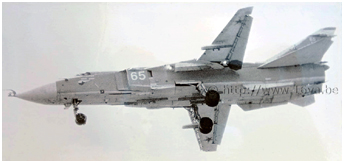 The arrival of the Su-24s at Brand in 1982 naturally sparked the interest among the military liaison missions (1).
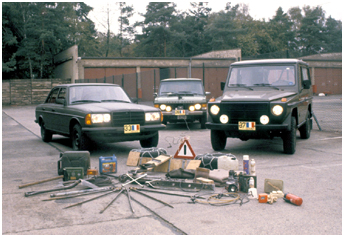
The GRU section in Potsdam responsible for military liaison missions had, in fact, taken the initiative by requesting the 5th Directorate of the Stasi's Hauptabeilung VIII (> Link) to increase surveillance around Brand airfield during June. A Soviet intervention group was also to reinforce the deployment. The operational group was in place from June 1st, but it was discovered, upon the arrival of the first "Fencers," that the MMFL personnel had evaded the increased security checks. On June 16, Long-Distance Liaison Vehicle (Véhicule de Grande Liaison - VGL) n°33, en route to the area, was placed under "operational surveillance." It arrived on site around 12:10 PM, and about ten Su-24s landed at irregular intervals throughout the afternoon. The French military personnel were observed along the approach path, frequently changing position while remaining approximately 3 km from the permanent restricted area surrounding the airbase. Taking advantage of the engine noise, East German and Soviet intervention forces managed to approach and encircle the vehicle at 1:55 PM. The VGL crew, taken by surprise, did not have time to retreat. Their notes and equipment, including an SX200 scanner used to eavesdrop on Stasi agents' conversations, were seized and photographed.
The arrival of the Su-24s at Brand in 1982 naturally sparked the interest among the military liaison missions (1).
The GRU section in Potsdam responsible for military liaison missions had, in fact, taken the initiative by requesting the 5th Directorate of the Stasi's Hauptabeilung VIII (> Link) to increase surveillance around Brand airfield during June. A Soviet intervention group was also to reinforce the deployment. The operational group was in place from June 1st, but it was discovered, upon the arrival of the first "Fencers," that the MMFL personnel had evaded the increased security checks. On June 16, Long-Distance Liaison Vehicle (Véhicule de Grande Liaison - VGL) n°33, en route to the area, was placed under "operational surveillance." It arrived on site around 12:10 PM, and about ten Su-24s landed at irregular intervals throughout the afternoon. The French military personnel were observed along the approach path, frequently changing position while remaining approximately 3 km from the permanent restricted area surrounding the airbase. Taking advantage of the engine noise, East German and Soviet intervention forces managed to approach and encircle the vehicle at 1:55 PM. The VGL crew, taken by surprise, did not have time to retreat. Their notes and equipment, including an SX200 scanner used to eavesdrop on Stasi agents' conversations, were seized and photographed.
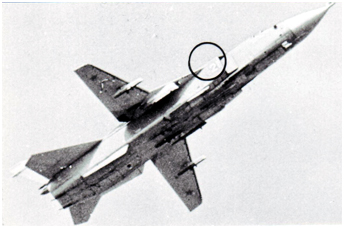
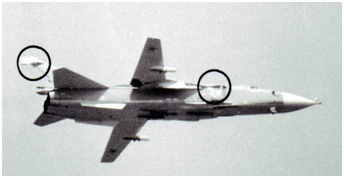 The MMFL members were handed over to the Komendatura in Cottbus at 4:00 PM - where it is assumed they were asked to sign an "Akt" acknowledging their "offenses," which they refused to do. They left at 5:50 PM after retrieving the seized equipment, with the exception of three rolls of photographic film and a magnetic tape containing the recording of the pilots' radio communications. This was the first time that a concrete evaluation of the equipment used by the MMFL's air section could be carried out.
The USMLM's Unit History report from the same year states that "On 23 June the first technical quality photos of FENCER C/C MOD were obtained at Brand Soviet Airfield. FENCER's deployment coincided with the phase-out of all FITTER A at Brand. FENCER's greater range and increased weapons load represent a major increase of Soviet air power in the forward area."
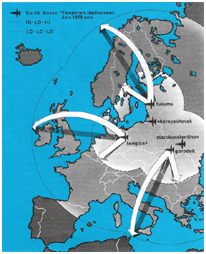
The Americans mention a later date for the photographs because Allied military liaison missions - except during special operations like the one described at the top of this page - operated on a rotational basis in one of three areas of assignment (> Map). These are therefore the first US photos mentioned here.
notes
(1)
The following text is based on information from a Stasi report entitled "Über die Blockierung und vorläufige Festnahme des f-MVM Fahrzeuge 33"
published in the book "Les Sentinelles Oubliées" by Roland Pietrini (MMFL).
 |
Plan du site - Sitemap |  |

